Literary London: From Hell Part 1

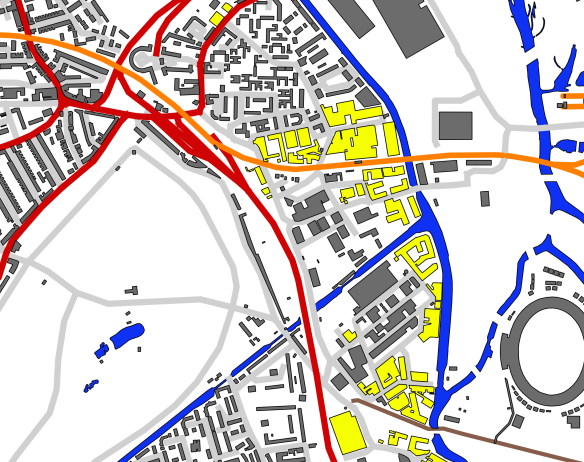
74 Brook Street, William Gull's home

74 Brook Street, William Gull’s home

Alan Moore and Eddie Campbell’s From Hell, their retelling of the Jack the Ripper murders, is a fascinating book about man and woman, the powerful and the powerless, the mystical and the rational, but most of all about time. The real and imagined history of London pervades it, and through murderer William Gull’s conjurations and sacrifices, he’s able to glimpse the (somewhat grim) future: the London of 1988 when Moore was writing (I need to reread that part of the graphic novel, but my recollection is that this is expressed mainly through the looming spectre of Centrepoint). It’s been a further 25 years since From Hell was penned, and time has added another layer, erasing locations quite key to Moore’s narrative, and leaving others intact; and the psychogeography and Ackroydian stories around the supposedly pagan churches of Hawksmoor perhaps aren’t quite as current or plausible as they may have seemed.

I wrote about walking William Gull’s coach route in From Hell nearly a year ago, but sadly the first attempt to walk it was rained off and later iterations suffered from ramblers asking awkward questions (e.g. “What is From Hell? Why are we walking this coach route? Who is Alan Moore? Where is Northampton? Can we go to the pub yet? and so on) until I gave up. The UCL festival of the arts has given me the opportunity to resurrect the project with PhD student Stephan Hugel, so we decided to capture the experience of travelling to and between these significant places using the full CASA/sensing arsenal: Google Maps for planning, GPS tracking for route finding, tweets, photos, audio recordings, movies, Instagram, instaquote and even Vine. One wag dubbed it “a cross between Iain Sinclair and Sir Clive Sinclair”.

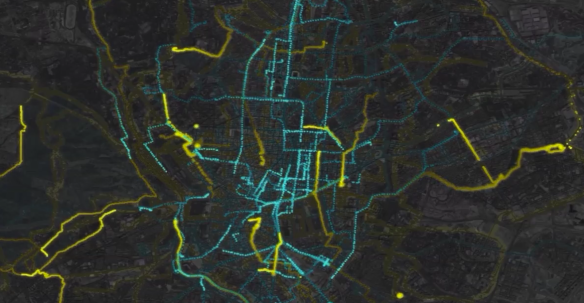
The walk is not unproblematic; from a planning perspective, even though there are quite detailed instructions, they’re for a coach/car, and require substantial amendments for a worthwhile walk. Pentonville Road is just not somewhere you want to walk along, even if deviation breaks the psychogeographical reality of recreating Gull’s route. There are large gaps between items of interest; less a problem for a car than a walker. The “misogynist psychopath trying to ensure the oppression of women for another hundred years” aspect wasn’t as problematic as I’d worried amongst my feminist friends, maybe because of the, shall we say, “unreliable” nature of the narrator, which became apparent through the readings. I suppose it’s worth pointing out that this traced the incantation stage of the book, and didn’t feature the victims or the murders at all; I would have felt a lot more self-conscious about the whole exercise if it had -  this was less a “Jack The Ripper” walk than a “mystical London” walk. This, in a nutshell, was the route, from Gull’s home at 74 Brook Street, to Bunhill Fields, William Blake’s final resting place:

fh1

This is just the first stage; there are at least two more. I’ll add more details in future posts, and some technical notes around gps visualisation – but if you want to hear about the walk, Stephan and I will be talking about it at the Something Else for the Weekend Festival at UCL on Saturday May 11th at 3.15pm. We look forward to seeing you.

Thanks to all our walkers and content-gatherers: Stephan Hugel, Panos Mavros, Kimon Daltas, Dawn H Foster, Alice Bell, Karishma Chandaria and Ahsan Nazir.

Travelling through time

Last week The Londonist kindly mapped out the locations of a variety of Dr Who themed spots in London, so the motivated nerd could plan a tour over Bank Holiday weekend. Some friends seemed keen, so I mapped out a route to cover as many of the central locations in a day as we could, ending up with a ramble which looked a bit like the route of the circle line:

(The basemap here was created by the Londonist, I’ve only added the route).

The bad news first: we didn’t quite finish it; we got tired by London Bridge and ended up in a riverside pub. The good news is that the Dr Who that night apparently featured the Shard, so that was coincidentally on-theme.

The thing is: I’m not a massive Dr Who nerd. I have an autographed Colin Baker book which ages me (35 years young) but I only own the books in which a Doctor dies, and despite the fact that my 13 year old incarnation once went to homebase dressed as the aforementioned Colin Baker doctor, I haven’t watched it since David Tennant took over because I got sick of it being set in Queens Road Peckham every episode (I lived in Peckham at the time).

This makes a fictional Dr Who tour of London problematic. The site where Silurians introduced the plague into London… well, that’s just Baker Street. The Yeti ravaging the London Underground made its home at… Goodge Street station, my regular commute. Trying to overlay a new iconography onto places with strong existing iconography, sense of place, or personal connection – well it just didn’t happen for me. I was walking with someone who was a big enough Dr Who fan to have made an iPad stylus from a sonic screwdriver, and she seemed similarly nonplussed.

I’ve been to other film and tv locations – notably Snoqualmie and North Bend, where David Lynch’s mystical gothic noir TV series Twin Peaks was shot, and Rosyln, home of the slightly-less-well-remembered 90s existential comedy Northern Exposure. These are small towns on a different continent, and obviously I had no pre-existing connection to them, so it was easy to overlay the fantasy and the fictional onto their roads and landmarks. New York, San Francisco – they are cinematic, they are iconic, but ultimately they are New York and San Francisco, not just the place where Harry met Sally or where Steve McQueen did a thing. London, I think, falls into the same category.

I’ve been promising for ages to organise a ramble which follows Alan Moore’s mystical route from From Hell – here, I hope, the way he’s shoved his fingers into the soil of London will mean the overlay is historical and in tune with the city. It will ring that which is there and yearning to ring, instead of being a shouted a grace note over a fugue.

On a final note, thanks to the Londonist for providing the inspiration – the walk is one that takes in Kensigton Palace, Hyde Park, Marylebone (including St Mary Le Bourne, widow of the Tyburn), Bloomsbury, and if you get all the way, the South Bank and some of the classic tourist spots; and the ramblers for rambling, especially if they weren’t even big enough Dr Who fans to remember Bonnie Langford.

When dancers and pigeons meet

20130314-101721.jpg

CASA had a bit of a mini outing to TEDx LSE at the weekend – I was speaking (on the topic “Ideas are Sociable”), and PhD students Panos Mavros and Steve Gray ran workshops on cognitive geography and social media, respectively. Additionally, we made the mistake of letting dancers Carina Arvizu and Karine Rathle loose on the Kinect-enabled PigeonSim – with incredible results:

(Mostly, they just used it in a normal way, but made it look way more graceful than anyone else:)

It was a great conference full of fascinating speakers – being in the same session as Helens Arney and Scales and Beau Lotto was a joy and privilege. I was manning the stand so didn’t see all the talks – but I was able to catch Ellie Saltmarshe’s talk on the value of polymathism, which particularly chimed with my own; and Paul Ormerod always has interesting things to say.

It was a lot of fun for us to find groups of people interested in mapping, sensing and the use of these increasingly ubiquitous and powerful technologies. For many people, use of these technologies, or developing these tools as a hobby, has great value – but if you want to take it a step further and are considering studying at a postgraduate level, we’ll be at the Bartlett Potgraduate Open Day on March 27th with Pigeon Sim and the London Data table, and on hand to chat about our research and the MRes course. The rest of the Bartlett will be there too, and it should be a really good day. The eventbrite is here if you want to sign up.

20130314-101721.jpg

Bartlett Postgraduate Open Day

Visitors to last year's Bloomsbury Festival chatting with CASA researchers about their work

Visitors to last year’s Bloomsbury Festival chatting with CASA researchers about their work

Roll up, roll up! The first annual Bartlett postgraduate open day takes place on March 27th 2013, and now’s the time for prospective Masters’ students to grab their free tickets before they all get snapped up!

The event is geared towards people who are considering studying a Master’s (postgraduate) degree at the Bartlett (these are usually completed in one year, or longer if you study part-time). If you’re not fully up to speed with UCL institutional structure, the Bartlett is the UCL Faculty of the Built Environment – meaning that it’s the parent organisation for a whole host of departments who are interested in cities, buildings and, well, building.

Obviously one of those CASA, where I work -  we’re interested in cities, technologies and analysing space, whether it be the city, the country, or the world. We’ll be at the fair to talk about our MRes in Advanced Spatial Analysis and Visualisation.The degree is designed to teach students about spatial modelling, visualisation and analysis, leading on to a student-led research project.

The Bartlett will shortly have a very useful page describing the differences between the various masters degrees, but for now, and in a nutshell:

An MRes is a research masters, meaning that at least 50% of it is based on a research topic that you select and write a dissertation on. There are fewer taught classes than MScs (see below). These degrees are great if you want to do future research in academia or industry, and are useful to demonstrate originality and independence. On our MRes there is both a group visualisation project and a larger individual research project, so you’ll get used to working in a team and individually.

An MSc is much more based on taught material, with some independent research. The Sc stands for “science” so requires some investigation and experimentation. CASA doesn’t currently run an MSc but plans to in the future.

An MA is like an MSc, but for Arts instead of Science. I’m not quite sure what they actually involve, I imagine a lot more book learning and hours in the library staring wistfully at other postgrads*. Doesn’t sound half bad.

Finally, an MArch is an architecture degree geared more towards design outputs and typically more portfolio-focussed. This is very much for architect-designers as opposed to urban geographers and data wranglers.

The Bartlett is a diverse place, and while I’d warmly encourage you to focus your academic brainpower on the CASA stall, there will also be people from the BSGS (who bring innovative computational techniques to design and architecture), the Energy Institute (looking at energy demand in the home and economy), the Institute for Sustainable Resources (a spinout of the Energy Institue), the Development Planning Unit (studying international development, aid, planning and building), Heritage Science (preserving historic artefacts) as well as the larger groups of Architecture (designing buildings), Planning (working out where they go), and Construction and Project Management (making sure they get built).*

If you’re reading this you’re probably most curious about CASA – I’ll be there talking about our research and the MRes, along with CASA lecturers Hannah Fry and James Cheshire, and former students Robin Edwards and Flora Roumpani, who can tell you how fascinating a CASA Masters Degree can be.

See you there!

*that’s a massive oversimplification

Walking the murals of London

This slideshow requires JavaScript.

Our most recent urban ramble outing was around the murals of southeast London† – based on maps created by The London Mural Preservation Society, a volunteer group who since 2010 have been working to identify and preserve community murals around London (if you’re inspired to check some of these out, I’d encourage you to make a small PayPal donation to the society for bringing them to (y)our attention and trying to bring attention to the ones that are getting neglected).

London walks almost inevitably cut through the strata of London society and history, if only architecturally. It’s more unusual to contact social (and socialist) history so directly. The first mural we saw was Riders of the Apocalypse – depicting Thatcher, Reagan, Heseltine (apparently the defence secretary when the mural was painted in the early 80s) and a rather effete Gorbachov as the four horsepeople of the apocalypse, riding cruise missiles around the world opposed by the forces of peace, agriculture, and I think womanhood and civilisation, but it could just as easily be “nuclear disarmament” and “doves”.

Murals in Poplar and Shadwell reflect more local stories, in the form of the Poplar Rates Rebellion and The Battle of Cable Street. I think that technically, the latter is the most impressive, depicting the confrontation between Oswald Mosley’s Blackshirts and the local Jewish/non-fascist populous in a Guernica-like tumult of sound and fury. These stories feel rooted in their locale, a permanent fixture, like an oral history, but painty. Not having gone to a school which is in London*, or remotely socialist**, and having not even got as far as GCSE history, these events from London’s recent past were new to me. And they’re rousing socialist tales of people standing up to violence and oppression, and by opposing, ending them – I can see why residents would want to remember them, especially in areas still affected by poverty and racism. For me, it was really interesting to see these stories told in the places they happened.

Some of these murals are “purely” decorative, as rambler James Coglan commented “London has too many grey surfaces – it needs brightening up”. Even these are reflective of their location – the playful His and Hers in Deptford stands next to a clothes market, and dresses up a chimney in a tie, and another in a string of pearls. The Deptford Marbles makes a landscape from an otherwise dull end-of-row with elements which incorporate the wall’s buttresses into a simple but dreamy trompe l’oeil.

Once you start looking, public art is everywhere – a mural here, a mosaic there, a totem pole somewhere else, a hidden jukebox tucked away by a railway bridge – all of which creates a storylike and fantastic quality to walking the city. They break up the relentless chatter of that other public art – advertising -  with an alternative narrative about where you are and who you want to be. Looking at London’s murals, I don’t worry about the state of my teeth or what car is shiniest – that’s replaced by story, place and playfulness. It might even have the by-product that I learn something.

†thanks to Alice Bell for spotting this and routeplanning

*Shropshire

**how does “Serve and Obey” strike you as a school motto? No, I am not joking.

The dangers of big data

dataTrain

Nassim N. Taleb dropped some truth in his recent piece for Wired, “Beware the Big Errors of Big Data”, letting us silly scientists (of data and social flavours) and statisticians in on a startling observation: with more data comes more noise, and more cherry-picking, and more false results.

Except he hasn’t, and it doesn’t, and it won’t.

Let me present a more nuanced rebuttal, firstly with the caveats: 1) I’m not a statistician, and so I’m only scratching the surface on that count and 2) I’m not a fan of Taleb’s work, I tried to read one of his books and gave up, and his role in public life seems to “The Malcolm Gladwell that David Cameron has heard of”.

Ok, enough of the ad hominem attacks – what’s his argument and why do I disagree with it? I would characterise his argument as being that big data is full of “noise” which is being interpreted as meaningful patterns and sold on to unsuspecting people as such by unscrupulous hucksters.

My problem with it is that it obscures a lot of subtlety to make obvious points. Point 1: Big Data allows “researchers” to “cherry pick”. Ok, but researchers can act in bad faith outside of big data. Our baseline assumption should be that researchers act in good faith, or at least we need checks and measures to prevent this. What’s special about big data? Well it’s so big and data-y that researchers might not know they’re doing this, or we have no way of catching them out because methods don’t exist to test these things.

Oh wait, they do. It’s called “statistics”.

One of the elisions Taleb’s made is between quantity of data and dimension of data. A high dimensional dataset might be someone’s Nectar card, say, where for each individual, we have thousands of pieces of information. I, or some hypothetical researcher, might look at their nectar card purchases, and that of their spouse, say, and conclude that people who buy New Girl DVDs are more likely to drink cheap lager. This would be a ridiculous extrapolation from a small group, and is related to the phenomenon of overfitting – assuming too much about your population from your sample.

One very simple way to deal with this is to collect more data. For our hypothetical Nectar card researcher, he might look at his children’s expenditure and notice no correlation between their consumption of cheap lager and their New Girl DVD habit. They might drink loads of cheap lager and never once see a Zooey Deschanel DVD. So the silly hypothesis is nipped in the bud.

If you don’t want to go out and collect new data, you can split your existing dataset – using one portion to form hypotheses, and another part to test it. There are lots of ways to do this, because – guess what – statisticians have been thinking about this problem for upwards of a hundred years and the concept of overfitting wasn’t invented during a TED talk.

I digress – this is just one way I know of dealing with “cherry picking”. Statisticians use many more. (@vonaurum has been particularly helpful on twitter in conversation, he’s made various comments on the effects of Boosting methods to reduce overfitting – but I’m not very knowledgeable on that subject, so I’ll leave those to him to elucidate).

The second point is that not all data is high-dimensional like Nectar data. (Statisticians also have techniques to reduce dimensions and simplify the information). Big data can just mean number of participants, or timepoints, which doesn’t necessarily imply high dimensionality.

On one level, Taleb is correct – very few people really understand stats (myself included!) and so we should be very cautious of the analyses we use. There are real issues about the quality of published data, and he links to studies on the subject. On the other hand, there’s a serious body of work behind getting this right, and painting data scientists as being deluded scoundrels does no one any favours. We shouldn’t say “oh noes” and give up – we should try harder to engage with the serious and significant scholarship that’s been done, and incorporate it into mainstream practice.

Smart Cities, Big Data and Social Physics

In December last year I delivered this lecture as part of of UCL’s lunch hour lecture series, with the title “Social Physics in the Big City” – one which let me bring in themes from Big Data, Open Data and Smart Cities* without explicitly mentioning or dwelling on any. I’ll admit to finding these slippery concepts.

Open Data is perhaps the most clear-cut of these – academics, public sector groups and NGOs sharing data in an accessible, transparent and machine-readable way. The Open Data Institute and organisations like Creative Commons and Digital Science are trying to encourage and commercialise the sharing of data, and to place data and data methods on a similar footing with publications to recognise the value of the work that goes into collecting these datasets and creating tools to understand them.

Big Data and Smart Cities are more amorphous. Big Data is typically defined in terms of heuristics which are synonyms for “big enough to make my brain hurt”. This is a convenient fudge to cover new ideas, slightly older ideas, and things people have been doing for ages. This happened when I worked in “nanotechnology” and the term was used to mean “nano-scale science” – so most of chemistry, biochemistry and materials science, and bits of physics, electronic engineering, and anything else you needed grant money for. I use “social physics” in a similar way in my lunch hour lecture to mean “quantitative social science” – I’m not hubristic enough to say that I know enough about geography or planning to lay claim to their expertise, but the basic philosophies aren’t new.

Smart Cities are a more important concept in some ways. The concept of sustainability seems to be a key way in which they differ from shiny hi-tech cities of the future. I think the question “for whom are these cities smarter?” is one we should be asking. At a time, in the UK at least, of massive inequality, will smart cities find ways to support the marginalised, or will it just be a way of further enhancing the lives of a technocratic elite? The Smart Cities concept claims to think about environment, energy and social needs, so it’s important to keep focussed on that and not get distracted by all the flying cars we’ll be travelling around in.

James Cheshire did a very good CASA seminar in January, touching on some of the methodological and disciplinary issues of big data, social media mining, and the interface between quantitative human geography and these techniques. It made a sober and reflective counterpoint to my more flag-waving talk, but unfortunately it wasn’t filmed; perhaps if you ask him really nicely he’ll turn it into a blog post? Suffice it to say, there are problems of data quality, framing and availability in quantitative geography which haven’t gone away “because Twitter”. The technologies we now have access to are indeed staggering, but there are methodological problems that don’t just disappear, and there are methodological problems we create by leaning heavily on the abundance of data. For academics, dealing with these in a systematic, logical, even scientific manner is a major challenge of big data, smart cities, and social physics (whatever that is).

*Typing this on an iPhone repeatedly throws up the typo “smart cuties”, which is of course the name of the 2013 calendar featuring the beautiful staff of CASA